Capital mobilisation
Through PIDG’s participation, ETAF is expected to mobilise up to USD 420 million of private capital demonstrating how the structure can unlock multiples of commercial investment for Asia’s energy transition.




| Company | Energy Transition Accelerator Financing Platform (ETAF) |
| Sector | Power/Energy |
| Country | Asia |
| Total Project Cost | USD 45 million |
| PIDG Commitment |
|
| Dates of PIDG involvement |
|
In 2025, the energy sector in Southeast and South Asia accounted for c. 13.5% of the global emissions as fossil fuels remained the leading source of energy generation. This region also has the largest investment gap to net zero requirement by 2050, which is estimated to be around USD 60-70 billion. On the financing side, it is estimated that the regions combined account only for 45% of private capital investment in the energy sector compared to a global average of 75%. Investments by institutional capital providers in the region are quite limited due to a mismatch of select investment preferences, characteristics and capital costs of energy transition projects.
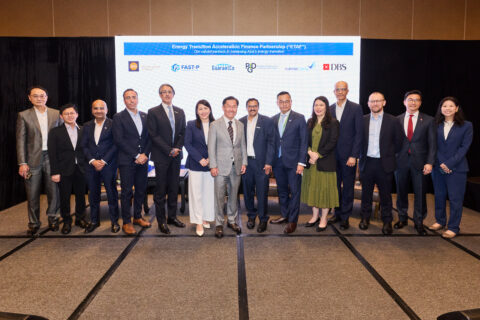
The Energy Transition Accelerator Financing Platform (ETAF) is a key pillar of the Monetary Authority of Singapore’s (MAS) Financing Asia’s Transition Partnership (FAST-P) initiative. PIDG, MAS, and Clifford Capital achieved the first close for ETAF with USD 250 million in committed capital for its displacement strategy during London Climate Action Week in June 2026.
MAS and PIDG are ETAF’s first close catalytic capital providers, with PIDG investing up to USD 15 million. While GuarantCo provided a USD 30 million guarantee for ETAF’s mezzanine financing structure, to enhance its risk-return profile and crowd in additional commercial investment.
Through PIDG’s participation, ETAF is expected to mobilise up to USD 420 million of private capital demonstrating how the structure can unlock multiples of commercial investment for Asia’s energy transition.
To address different transition pathways in Asia, ETAF adopts (i) a displacement strategy which supports investments in grid modernisation and other energy transition infrastructure projects to accelerate the displacement of fossil fuel-based power generation; and (ii) a replacement strategy focusing on replacing coal-fired power generation with lower-emissions power sources.
Through this landmark transaction, PIDG demonstrates how targeted investment in a fund structure can unlock multiples of commercial capital mobilisation into investment areas – a model replicable at scale.
Mobilising capital at scale requires not just innovative structuring but creating shared best in class approaches – enabled by PIDG providing impact services to the ETAF manager in this transaction.