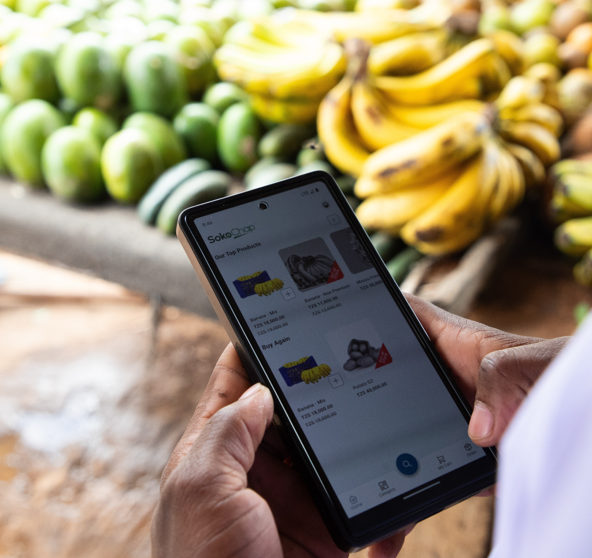
Photograph courtesy of East Africa Foods.
The proceeds will fund EAF’s next phase of expansion: expanding processing, storage and logistics capacity, the digital platform that runs it, and the move into new markets. EAF aims to reach 100,000 smallholder farmers over the next few years, cutting food waste across its network by a third.
EKTA Partners acted as the exclusive financial advisor for the transaction.
In Kenya and Tanzania, up to 40% of food produced is lost before it reaches a consumer. Very little of that loss happens in the field. It happens in the days and weeks after harvest, in the absence of aggregation, grading, storage and reliable transport — the infrastructure that determines whether a smallholder farmer sells at a fair price or sells at a loss, and whether an urban family pays a stable price or a seasonal one. The pattern is not particular to East Africa. The same gap between what the land produces and what reaches a consumer exists across much of the continent, and can be closed the same way everywhere: by building the infrastructure between farmers and urban retailers.
EAF was built to close that gap, and today cuts that loss by a third across its own network. The company sources directly from more than 28,000 registered smallholder farmers, aggregates, grades, stores and processes their produce, and delivers it to more than 10,000 urban retailers. Its produce reaches consumers under the group’s own brands, including Onja and Golden Banana.
The next phase is to consolidate that position across the region while exploring opportunities beyond it. The ambition is to achieve African food supply chain infrastructure that is African-owned, African-operated, and built to hold up under the climate shocks the next decade will bring.
Elia Timotheo, Founder and Chief Executive Officer of East Africa Foods, said: “A third of what our farmers grow never reaches anyone’s table. That is not a farming problem: it is an infrastructure problem, and it is solvable. For the past three years we have been building the layer this market is missing: the sourcing network, the fleet, the storage, and the technology that sit between a smallholder farm and an urban shelf. This investment enables us to further improve and scale this physical and digital infrastructure. We would like to thank our investors for their support in scaling this vital infrastructure.”
Claire Jarratt, PIDG Head of Investment Management for InfraCo, said: “EAF’s offering aligns well with PIDG’s mandate to deliver inclusive, climate-resilient growth across the countries in which we operate. Strengthening EAF’s presence in Tanzania, and expanding its efficient, data-driven business into Kenya, will enable the company to mobilise future finance into this vital sector, underpinning improved food security across the region.”
Alongside the physical infrastructure, EAF will extend training for smallholder farmers in climate-smart production methods and expand the digital systems that connect farmers, branches, and retailers, built in Tanzania, and designed to be deployed in each new market. It is anticipated that up to 100,000 smallholder farmers, 45% of them women, will benefit from higher and more predictable incomes and improved climate resilience, with urban retailers gaining better quality control, product traceability, and availability through EAF’s formalised systems.
Samuel Kibiri, Senior Equity Officer at Oikocredit, said: “At Oikocredit, we believe that building climate-resilient food systems requires investment in the infrastructure that connects farmers to markets efficiently and sustainably. EAF’s integrated aggregation, storage, processing, and distribution platform helps reduce food loss across the value chain, strengthen food security for growing urban populations, and improve the resilience and incomes of smallholder farmers. By improving supply chain efficiency and creating value across the food system, EAF is well positioned to deliver lasting impact, sustainable growth, and attractive financial returns as it scales across East Africa. We are proud to support EAF on this journey and to invest alongside like-minded partners.”
Peter Byrde, Director Private Equity at FMO, said: “Through our partnership with East Africa Foods, we have seen how investments in logistics, storage, processing, and digital solutions can reduce food loss, improve market access, and increase income opportunities for smallholder farmers. That’s why FMO is pleased to support EAF’s next phase of growth as it expands critical supply chain infrastructure across the region, helping to build a more efficient, resilient, and inclusive food system. By demonstrating a scalable and commercially viable model for agri-logistics, we believe EAF can help catalyze greater private sector investment into the sector and pave the way for increased commercial funding in the years ahead.”
The transaction
East Africa Foods (EAF) has raised USD 26 million in Series B equity, led by the Private Infrastructure Development Group (PIDG) through its growth equity and project development solution InfraCo, alongside Oikocredit and FMO (Dutch Entrepreneurial Development Bank). The equity round completes a broader capital raise of approximately USD 40 million, including investment from existing shareholders, along with debt funding from The Schmidt Family Foundation. Completion of the equity investment follows competition and regulatory clearances in COMESA, EAC FCC (Tanzania), and ZFCC (Zanzibar).